

Why two closely located systems can be connected, affected differently, and studied in different ways.
Hearing and balance are often discussed together. That makes sense: both systems have important structures inside the inner ear, and both use specialized sensory cells to detect movement. But hearing and balance are not the same function, and they do not rely on exactly the same biology.
Understanding the difference can help families make sense of why one genetic condition may mainly affect hearing, another may mainly affect balance, and another may affect both.
A useful comparison: Hearing and balance are like neighbors in the same small building. They share some construction features and communication pathways, but each has a different job.
Two systems in one small space
The inner ear sits deep within the skull. Its hearing organ is the cochlea, a curled, fluid-filled structure often described as snail-shaped. Nearby is the vestibular system, which includes three semicircular canals and two small organs called the utricle and saccule (NIDCD, 2018, 2022).
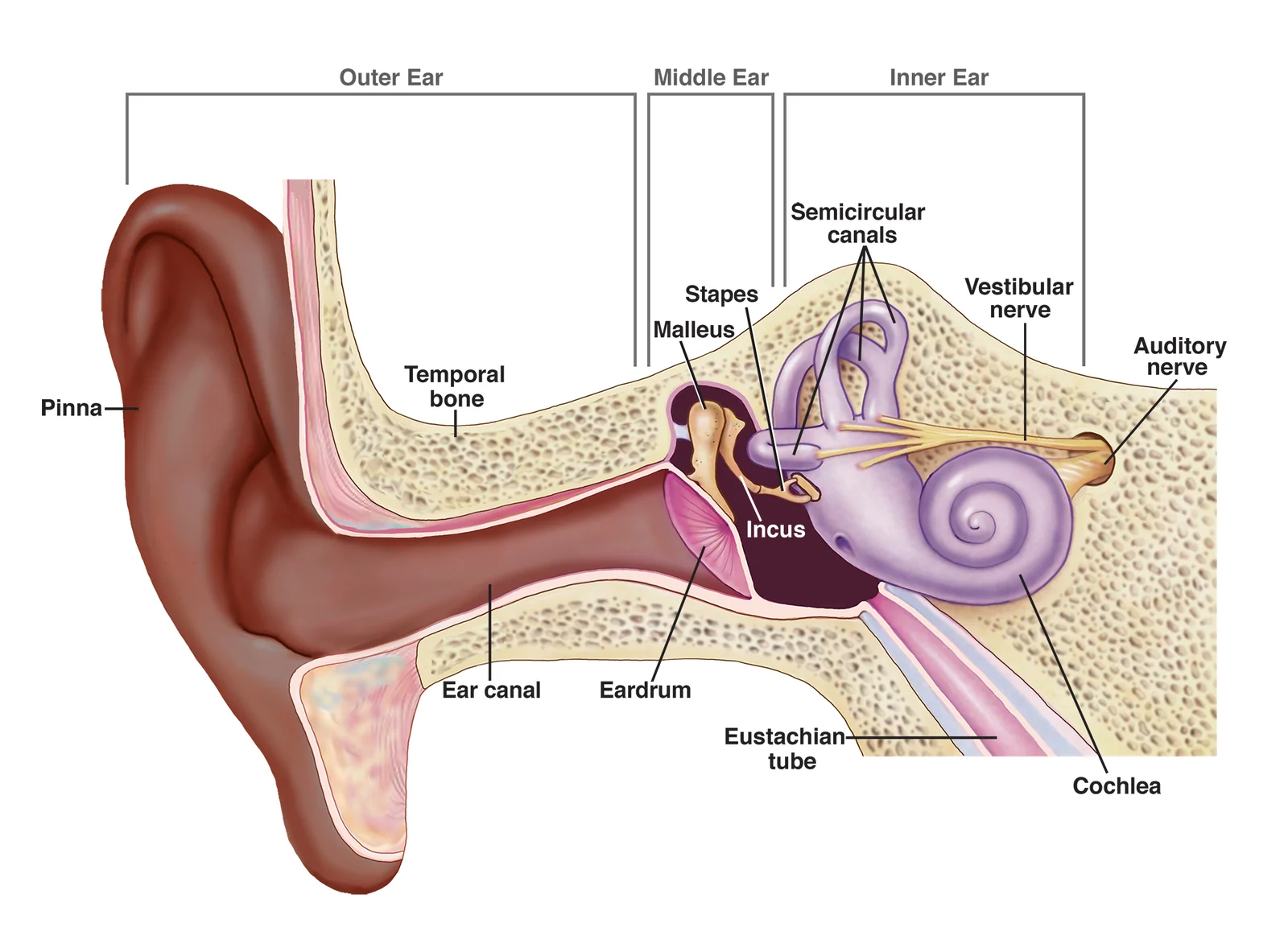
The cochlea helps the brain interpret sound. The vestibular organs help the brain understand head movement, position, and gravity. These balance signals work together with information from the eyes, muscles, and joints to help the body remain upright, move through space, and keep vision steady while the head is moving.
How each system works
Both systems begin with movement, but they are measuring different things.
How hearing begins
Sound creates vibrations that travel through the outer and middle ear to the cochlea. Fluid movement inside the cochlea bends tiny projections on sensory hair cells. This movement is converted into electrical signals that travel along the auditory nerve to the brain (NIDCD, 2022).
Different parts of the cochlea respond best to different sound frequencies. That organization helps the brain distinguish a low-pitched rumble from a high-pitched birdcall or the fine details of speech.
How balance begins
Balance also depends on movement, but the vestibular system is measuring something different. The semicircular canals detect head rotation. When the head turns, fluid inside the canals moves and bends sensory structures, creating signals about the direction and speed of that turn (NIDCD, 2018).
The utricle and saccule help detect straight-line movement and the head’s position relative to gravity. Tiny mineral particles add weight to a gel-like layer above sensory cells. As the head tilts or the body accelerates, that layer shifts and helps the cells signal what is happening (NIDCD, 2018).
What the two systems share
Both systems use hair cells, sensory cells named for the microscopic projections on their surface. Those projections are called stereocilia; they are not ordinary hairs. In both systems, bending these structures helps turn physical movement into a signal the nervous system can use.
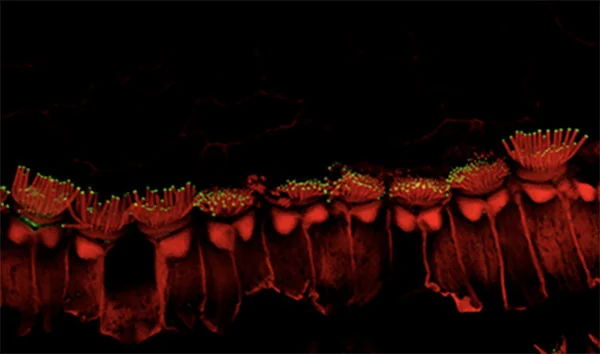
The systems also develop near one another and share some proteins, fluid environments, and cellular machinery. Because of this overlap, a change in one gene can sometimes influence both hearing and balance.
Why they can still be affected differently
Shared features do not make the two systems identical. A gene may be especially important in one type of sensory cell, in one part of the inner ear, or during one stage of development. Even when a protein is present in both hearing and balance organs, it may perform different jobs or be needed at different levels.
This helps explain several possible patterns:
- A condition may affect hearing without causing noticeable balance symptoms.
- A condition may affect balance more strongly than hearing.
- Hearing and balance may both be affected, but at different ages or with different levels of severity.
- People with changes in the same gene may not have identical experiences.
At a glance
| Hearing | Balance | |
|---|---|---|
| Main structure | Cochlea | Semicircular canals, utricle, saccule |
| What it detects | Sound vibrations across frequencies | Head rotation, straight-line movement, gravity |
| Sensory cells | Hair cells with stereocilia | Hair cells with stereocilia |
| Signal travels via | Auditory nerve | Vestibular nerve |
| Typical measures | Thresholds, speech understanding, otoacoustic emissions | Eye movement, response to head motion, posture |
Balance symptoms are not always obvious
Balance problems do not always look like dramatic spinning vertigo. In children, they may appear as delayed motor milestones, difficulty walking in the dark, frequent falls, or challenges with activities that require coordination. Adults may describe unsteadiness, blurred vision during head movement, dizziness, or feeling less secure on uneven ground.
These signs can have many causes, including causes outside the inner ear. Their presence does not prove that a genetic or vestibular condition is involved. Evaluation by qualified health professionals is important when symptoms are concerning.
Why researchers may measure the systems separately
A standard hearing test cannot fully describe balance function, just as a balance test cannot replace an audiogram. Researchers use different tools depending on the question. Hearing studies may measure sound thresholds, speech understanding, otoacoustic emissions, or auditory nerve and brainstem responses. Vestibular studies may measure eye movements, responses to head motion, posture, or how different balance organs are functioning.
When a gene is involved in both systems, studying both can reveal a more complete picture of the condition. It can also help researchers choose the right outcomes for a future study. An intervention aimed at balance biology should not be judged only by hearing results, and the reverse is also true.
MYO7A as an example of shared inner-ear biology
MYO7A provides one example of why the hearing-and-balance connection matters. The gene provides instructions for making myosin VIIA, a protein important in sensory hair cells. Changes in MYO7A are associated with more than one clinical pattern, including conditions involving hearing and, in some cases, balance or vision.
In Rescue Hearing’s 2026 announcement, the MYO7A gene-therapy program acquired by MED-EL was described as being developed to address a genetic cause of balance disorders. That focus is a reminder that inner-ear therapeutic research is not limited to hearing thresholds. Vestibular function and daily balance can also be meaningful research areas (Rescue Hearing Inc., 2026).
The takeaway
Hearing and balance share the inner ear, but they ask the body to solve different problems. The cochlea turns sound vibrations into information the brain can interpret. The vestibular system detects head movement and gravity so the brain can guide posture, movement, and stable vision.
Their shared biology can create overlap, but it does not make every hearing condition a balance condition, or every balance problem a hearing problem. Looking at both systems with the right tests can give families, clinicians, and researchers a clearer understanding of what a specific genetic condition is doing.
This article is provided for general educational purposes and does not offer medical advice. Questions about hearing, balance symptoms, genetic testing, or treatment should be discussed with qualified hearing-health and genetics professionals.
References
National Institute on Deafness and Other Communication Disorders. (2018, March 6). Balance disorders. National Institutes of Health.
National Institute on Deafness and Other Communication Disorders. (2022, March 16). How do we hear? National Institutes of Health.
Rescue Hearing Inc. (2026, June 10). MED-EL acquires two gene therapy programs targeting genetic causes of balance and hearing disorders.