

A plain-language look at the questions researchers ask before a genetic condition can become a therapy program.
The phrase “gene therapy” can sound simple: identify a gene that is not working as expected, then fix or replace it. In reality, finding a genetic cause is only the beginning. Researchers must answer a long list of biological, engineering, and safety questions before a disorder can become a realistic target for a gene-therapy program.
This distinction matters for people and families living with genetic hearing loss. A gene may be known to cause hearing loss without there being an available therapy for that gene. Even when early laboratory results are encouraging, years of additional research may be needed before a potential approach can be studied in people.
The basic idea: A promising target is not simply a gene connected to hearing loss. It is a genetic condition for which scientists understand the problem well enough to design, deliver, and carefully evaluate a possible intervention.
First, what is a gene-therapy target?
Genes are sections of DNA that carry instructions used by cells. Many genes provide instructions for making proteins, which perform specific jobs inside the body. If a harmful genetic change keeps an important inner-ear protein from working properly, hearing or balance may be affected (National Cancer Institute, n.d.).
A “target” is the specific biological problem researchers hope to address. That target may include the gene, the missing or altered protein, the affected type of inner-ear cell, and the process that is no longer working as it should.
Seven questions researchers ask
No single test decides whether a genetic condition can become a therapy program. The assessment is cumulative, and a weakness in any one area can hold a program back even when the others look promising.
1. Is the genetic cause clearly understood?
Researchers first need strong evidence that changes in a particular gene actually cause the condition. They also need to understand how those changes affect the body. Does the gene fail to produce a needed protein? Does it produce a protein that cannot do its job? Or does it disrupt a larger system inside the cell?
This is one reason genetic hearing loss cannot be treated as a single disease. Two people may have similar results on a hearing test while the biological causes of their hearing loss are completely different. A strategy designed for one gene may not work for another.
2. Which cells need to be reached?
The inner ear contains several highly specialized cell types. Some genes are important in sensory hair cells, which help convert movement into nerve signals. Other genes affect supporting cells, connections between hair cells and nerves, or structures around the cells (National Institute on Deafness and Other Communication Disorders [NIDCD], 2022).
Researchers need to identify the right cell and, often, the right part of that cell. A therapy delivered to the wrong place may not address the underlying problem, even if it carries the correct genetic instructions.
3. Are the needed cells still present?
A potential gene therapy generally needs living cells that can receive and use its instructions. In some genetic conditions, the relevant cells may be present but working incorrectly. In others, cells may become damaged or disappear over time. This can make the timing of intervention an important research question.
That does not mean there is one universal “best age” for gene therapy. The biological window may differ by gene, variant, cell type, and individual. Researchers need natural-history data, meaning information about how a condition usually changes over time, to understand that window.
4. Can the genetic instructions be delivered?
Gene therapies commonly use a delivery vehicle, often called a vector, to carry genetic material into cells. One frequently studied type is an adeno-associated virus, or AAV. The vector is engineered for a research purpose; it is not simply a natural virus placed into the ear.
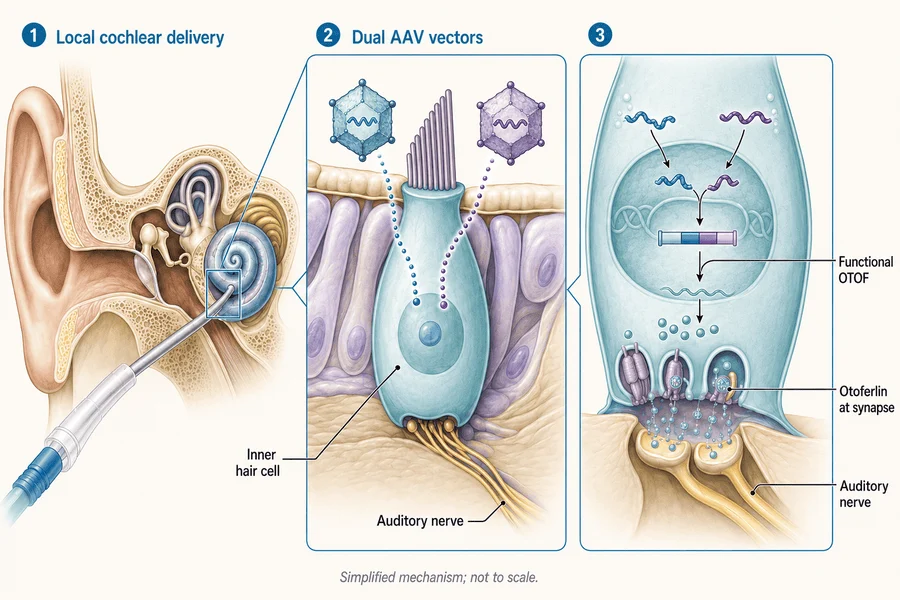
Delivery creates several practical questions: Can the vector reach the intended inner-ear cells? Can it carry the needed genetic material? Will enough cells receive it? Can the dose be controlled? And can the procedure be performed without causing unacceptable harm?
5. Does the proposed strategy match the genetic problem?
“Gene therapy” includes more than one strategy. Researchers may investigate adding a working copy of a gene, changing how a gene is expressed, editing a specific DNA sequence, or using another method to restore a missing function. The best approach depends on the disease mechanism.
For example, adding a working instruction may be considered when loss of function is the central problem. A different approach may be required if an altered gene produces something harmful. The strategy must match the biology.
6. Can researchers measure a meaningful result?
Before testing a potential therapy, researchers must decide how they would know whether it worked. Hearing thresholds are one possible measure, but they are not the only one. Studies may also examine speech understanding, inner-ear responses, nerve activity, balance function, daily functioning, or changes over time.
A laboratory sign that a protein is present is useful, but it is not automatically the same as a meaningful benefit in a person’s life. Research programs need measures that connect biological activity with safety and clinically meaningful outcomes.
7. What does the evidence show before human studies?
Potential therapies are studied through laboratory and preclinical research before they can be considered for clinical trials. Researchers examine whether the approach reaches the target, restores the intended biological function, produces measurable effects, and raises safety concerns (U.S. Food and Drug Administration [FDA], 2024).
Results in cells or animal models can provide important evidence, but they do not guarantee the same result in people. Human inner-ear anatomy, immune responses, dosing, disease stage, and outcome measures can create additional challenges.
At a glance
| Question | What researchers are assessing |
|---|---|
| Is the cause understood? | Strong evidence that changes in the gene cause the condition, and how |
| Which cells? | The specific inner-ear cell type, and often the part of that cell |
| Are cells still present? | Whether target cells remain able to receive and use instructions |
| Can it be delivered? | Whether a vector can reach enough cells at a controlled dose |
| Does the strategy fit? | Whether the approach matches the underlying disease mechanism |
| Can results be measured? | Outcomes connecting biological activity to meaningful benefit |
| What does evidence show? | Preclinical findings on targeting, function, effect, and safety |
Why one successful program does not answer every question
Progress for one form of genetic hearing loss can provide proof that gene-based approaches are possible in the inner ear. It can also help the broader field learn about delivery, trial design, and measurement. But each gene creates its own biological problem. Evidence from one condition cannot automatically be applied to another.
This is also why a genetic diagnosis is increasingly relevant to research. It can help define the specific condition being studied. It does not, by itself, mean that a person is eligible for a therapy or clinical trial.
How this connects to Rescue Hearing
Rescue Hearing developed gene-therapy programs focused on MYO7A and STRC, two genes connected to different inner-ear functions. In 2026, MED-EL acquired the programs and the rights to further develop, advance, and potentially commercialize them. The announcement described the MYO7A program as addressing a genetic cause of balance disorders and the STRC program as targeting a genetic cause of hearing disorders (Rescue Hearing Inc., 2026).
The transaction illustrates a broader point: moving from genetic knowledge toward a potential therapy requires focused scientific work and continued development. These remain research programs, and words such as “potential” matter. Development can reveal both possibilities and limitations.
The takeaway
A gene becomes a potential therapeutic target only when researchers can connect several pieces: the genetic cause, the affected cells, a delivery strategy, a measurable outcome, and evidence supporting continued study. That process is careful by design. For families following the field, understanding these steps can make gene-therapy news easier to interpret, and help separate scientific progress from promises that research has not yet established.
This article is provided for general educational purposes and does not offer medical advice. Questions about hearing, balance symptoms, genetic testing, or treatment should be discussed with qualified hearing-health and genetics professionals.
References
National Cancer Institute. (n.d.). Gene. NCI Dictionary of Cancer Terms.
National Human Genome Research Institute. (n.d.). Gene therapy. Talking Glossary of Genomic and Genetic Terms.
National Institute on Deafness and Other Communication Disorders. (2022, March 16). How do we hear? National Institutes of Health.
Rescue Hearing Inc. (2026, June 10). MED-EL acquires two gene therapy programs targeting genetic causes of balance and hearing disorders.
U.S. Food and Drug Administration. (2024, January). Human gene therapy products incorporating human genome editing: Guidance for industry.