
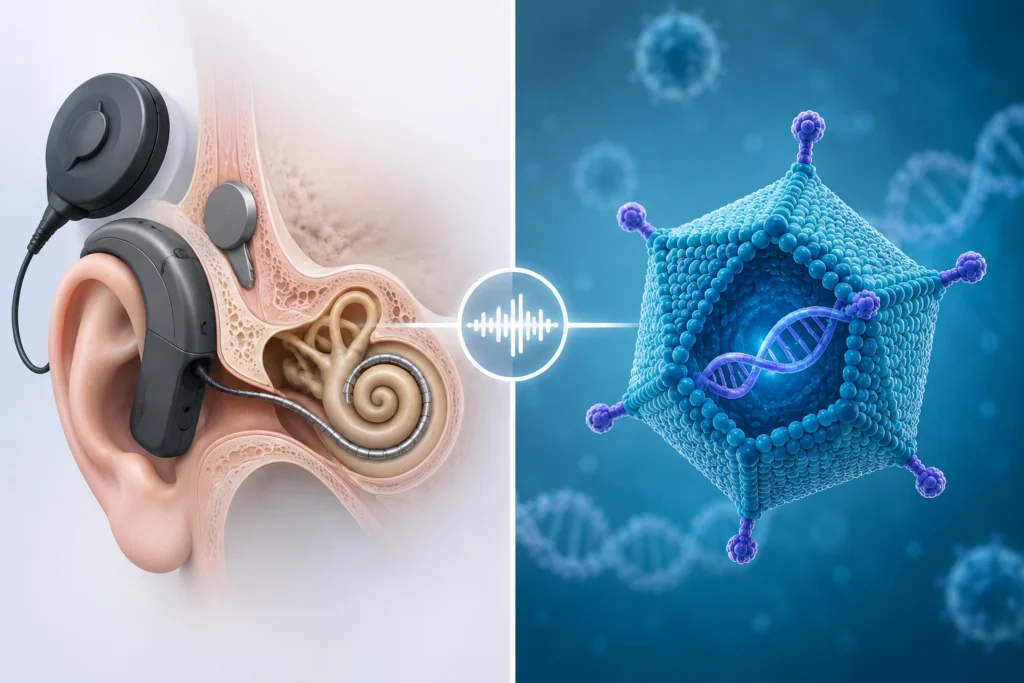
A practical guide to understanding what each approach does, who may be evaluated, and why the right next step depends on the individual.
The quick answer
Hearing aids, cochlear implants, and gene therapy can all have valid roles in hearing care. They are not a simple ranking from “basic” to “advanced,” and they are not always mutually exclusive. A person may use one approach, different approaches in each ear, or more than one approach over time. The right plan depends on the type, degree, and cause of hearing loss, along with anatomy, age, communication goals, medical history, and current treatment eligibility.
This guide is designed to help families and individuals get oriented before speaking with an audiologist, an ear, nose, and throat physician, or another qualified hearing specialist. It provides general education, not medical advice.
Start with the diagnosis, not the device
Hearing loss is a description of a hearing difference, not a complete diagnosis. A professional evaluation can help identify whether the hearing loss is conductive, sensorineural, mixed, or related to another part of the auditory system. Testing may also describe its severity, pattern, and whether one or both ears are affected (Shearer et al., 2026).
That information helps the care team decide whether amplification, an implant evaluation, genetic testing, medical treatment, communication support, or another service should be considered. For infants and young children, age-appropriate tests may include auditory brainstem response testing, otoacoustic emissions, and behavioral hearing tests. The exact evaluation depends on the person’s age, development, and ability to respond during testing (Shearer et al., 2026).
Why genetic testing may matter early
Genetic testing does not replace a hearing evaluation, but it can help explain the cause of hearing loss for some people. A confirmed genetic diagnosis may provide information about prognosis, associated health considerations, family recurrence, and whether a gene-specific therapy or research program is relevant (Shearer et al., 2026).
Genetic results can also be uncertain or may not identify a cause. They should be interpreted with a qualified healthcare professional or genetic counselor. A genetic diagnosis does not automatically mean that an approved gene therapy is available.
Approach 1: Hearing aids
How hearing aids work
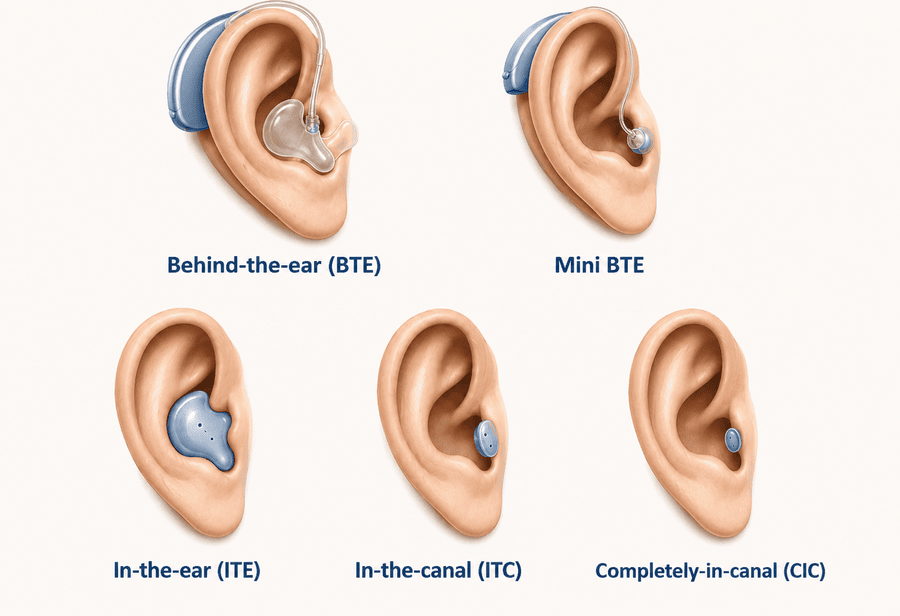
A hearing aid is a small electronic device worn in or behind the ear. It uses a microphone, amplifier, and speaker to make selected sounds louder. Hearing aids can improve access to speech and environmental sounds when enough auditory function remains for amplified sound to be useful (National Institute on Deafness and Other Communication Disorders [NIDCD], 2022).
Hearing aids do not restore typical hearing, and there are limits to how much amplification can help. Benefits vary with the type and degree of hearing loss, the device, the quality of the fitting, consistent use, and the listening environment.
Who may be evaluated
Hearing aids may be considered for children and adults across a wide range of hearing levels. Over-the-counter hearing aids are intended for adults with perceived mild to moderate hearing loss. Prescription hearing aids are fitted and programmed by a hearing professional and may be appropriate when hearing loss is more significant, complex, or involves a child (NIDCD, 2022).
What ongoing care can involve
Follow-up may include programming adjustments, hearing checks, maintenance, communication strategies, and support in home, school, work, or social settings. A person who receives limited benefit from appropriately fitted hearing aids may be referred for additional evaluation, including a cochlear implant assessment.
Approach 2: Cochlear implants
How cochlear implants work
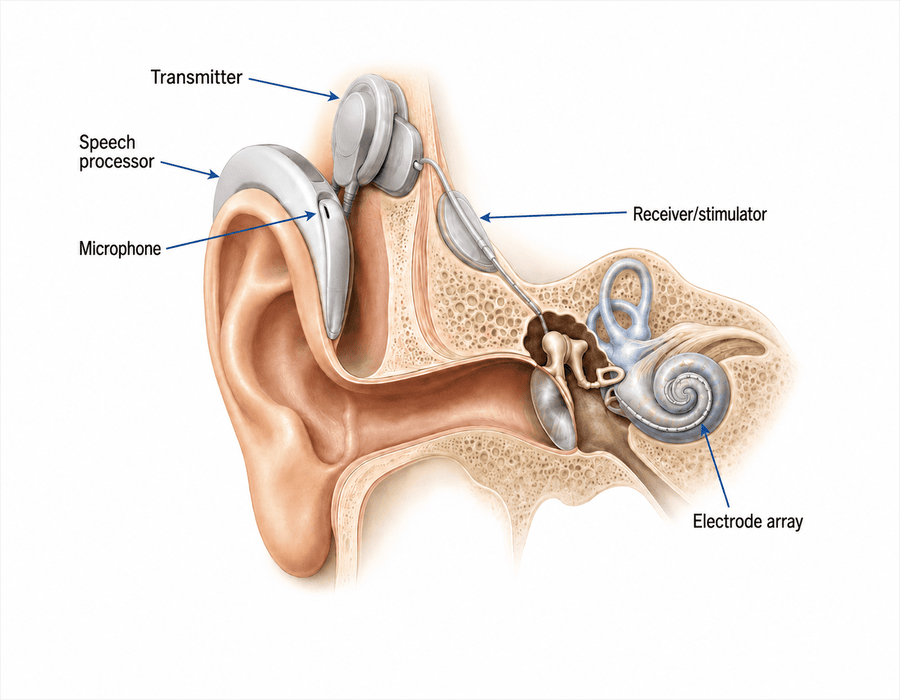
A cochlear implant is an electronic medical device with external and surgically implanted parts. Unlike a hearing aid, which amplifies sound, a cochlear implant bypasses damaged portions of the inner ear and directly stimulates the auditory nerve. It does not restore typical hearing. Instead, it provides a representation of sound that the brain learns to interpret (NIDCD, 2024).
The system includes a microphone, sound processor, transmitter and receiver-stimulator, and an electrode array. The processor converts sound into electrical signals that are delivered to the auditory nerve.
Who may be evaluated
Children and adults who are deaf or severely hard of hearing may be evaluated for a cochlear implant. Candidacy is individualized and can include hearing and speech-perception testing, review of benefit from appropriately fitted hearing aids, medical imaging, inner-ear and auditory-nerve anatomy, surgical considerations, and communication goals (NIDCD, 2024).
What ongoing care can involve
Cochlear implantation requires surgery and follow-up. Programming, listening practice, rehabilitation, and support from audiologists and speech-language professionals may be part of the process. Outcomes vary, and not everyone experiences the same benefit (NIDCD, 2024).
Approach 3: Gene therapy
How gene therapy works
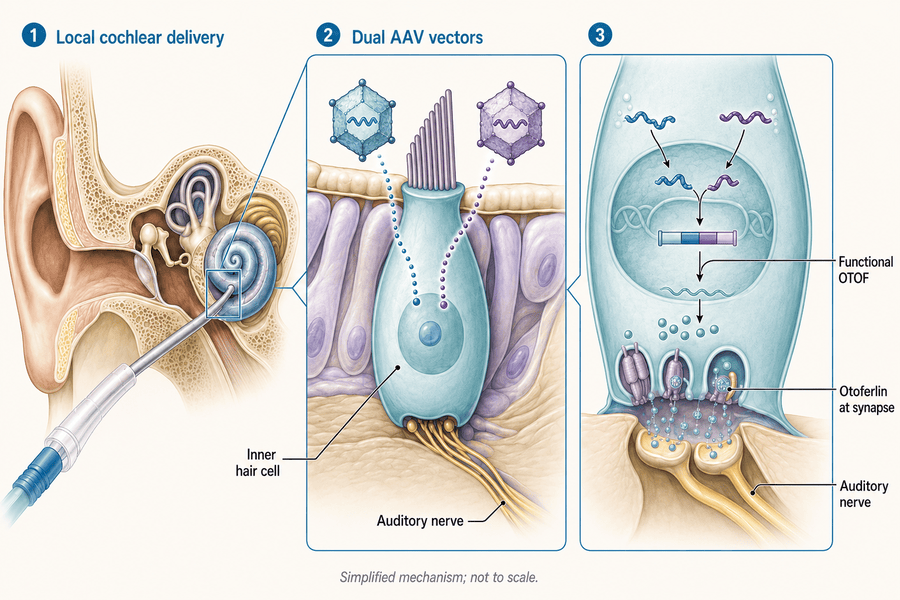
Gene therapy is designed to address a defined genetic cause of hearing loss. Some approaches use an adeno-associated virus vector to deliver a functional copy of a gene to targeted cells in the inner ear. The goal is to help those cells produce a protein needed for auditory function or signaling.
Gene therapies are highly specific. A therapy developed for one gene or set of variants would not automatically apply to hearing loss caused by another gene, aging, noise, infection, medication, injury, or an unknown cause.
Where gene therapy stands today
On April 23, 2026, the U.S. Food and Drug Administration approved Otarmeni (lunsotogene parvec-cwha), the first gene therapy approved for genetic hearing loss. The indication is limited to pediatric and adult patients with severe-to-profound or profound sensorineural hearing loss associated with molecularly confirmed variants in both copies of the OTOF gene. Eligibility also includes specific hearing, cell-function, anatomy, and treatment-history criteria (U.S. Food and Drug Administration [FDA], 2026).
Otarmeni is administered surgically into the cochlea and delivers a functional copy of OTOF to inner hair cells. The FDA granted accelerated approval based on an ongoing study, and continued approval may depend on confirmation of durability and clinical benefit. Gene therapies for other genetic causes of hearing and balance disorders remain at different stages of research and clinical development (FDA, 2026).
Who may be evaluated
Evaluation begins with a confirmed molecular diagnosis that matches an approved therapy or a specific clinical study. Other considerations can include degree and pattern of hearing loss, inner-ear cell function, anatomy, age, prior procedures in the same ear, and the detailed criteria for the therapy or study.
How the three approaches may fit together
These approaches should not be presented as a required sequence or as three choices that can never overlap. Hearing aids may provide useful access to sound for many people. A cochlear implant may be considered when hearing aids provide limited benefit and implant criteria are met. A gene therapy may be relevant only when the genetic diagnosis and other eligibility requirements match a specific treatment or study.
In real-world care and research, different approaches may be used in different ears or at different times. For example, a person might continue using a cochlear implant in one ear while being evaluated for a gene-specific therapy in the other. Whether approaches can be combined or used sequentially depends on product labeling, study design, prior treatment in the same ear, anatomy, and specialist guidance.
At a glance
| Approach | What it does | Current role |
|---|---|---|
| Hearing aids | Amplify selected sounds so the remaining auditory function can use them. | Established option for children and adults who can benefit from amplification (NIDCD, 2022). |
| Cochlear implants | Bypass damaged inner-ear structures and electrically stimulate the auditory nerve. | Established surgical option for qualifying children and adults (NIDCD, 2024). |
| Gene therapy | Targets a defined genetic cause by delivering functional genetic instructions to selected cells. | FDA-approved for a defined OTOF-related indication; other gene-specific uses remain in research or development (FDA, 2026). |
Questions to discuss with a care team
- What type, degree, and pattern of hearing loss has been identified?
- What benefit is being received from appropriately fitted hearing aids?
- Would a cochlear implant evaluation be appropriate?
- Could genetic testing or genetic counseling help clarify the cause?
- If a genetic cause is confirmed, is there an approved therapy, clinical study, or natural-history program for that diagnosis?
- Could different approaches have roles in different ears or at different times?
- What are the risks, limitations, follow-up needs, and realistic goals for each approach?
- How can communication and language access be supported while decisions are being made?
The broader direction of hearing care
Hearing aids, cochlear implants, and gene therapy represent different tools in hearing science, and all three continue to evolve. Hearing aids and cochlear implants can improve access to sound, while gene therapy is expanding options for narrowly defined genetic diagnoses (NIDCD, 2022, 2024; FDA, 2026).
The goal is not to rank one technology above another. The most appropriate plan depends on the individual and may involve more than one tool, used in coordination with a multidisciplinary care team.
A practical next step
If you are concerned about your hearing or a family member’s hearing, start with a comprehensive hearing evaluation. Bring your questions and any available hearing-test results, medical records, family history, and genetic reports. Ask the care team to explain the cause of the hearing loss when known, the options that are available now, and which specialists may be helpful.
For families, communication access matters throughout the process. Spoken language, sign language, visual communication, listening technologies, and combined approaches may all be part of an individualized plan.
This article is provided for general educational purposes and does not offer medical advice. Eligibility, risks, benefits, and treatment decisions should be discussed with qualified hearing, medical, and genetics professionals.
References
National Institute on Deafness and Other Communication Disorders. (2022, October 11). Hearing aids. National Institutes of Health.
National Institute on Deafness and Other Communication Disorders. (2024, June 13). Cochlear implants. National Institutes of Health.
Shearer, A. E., Hildebrand, M. S., Odell, A. M., & Smith, R. J. H. (2026). Genetic hearing loss overview. In M. P. Adam, S. Bick, G. M. Mirzaa, et al. (Eds.), GeneReviews®. University of Washington, Seattle.
U.S. Food and Drug Administration. (2026, April 23). FDA approves first-ever gene therapy for treatment of genetic hearing loss under National Priority Voucher Program.
World Wide Web Consortium. (n.d.). How to meet WCAG (Quick Reference): WCAG 2.2.