

A first approved therapy, a new trial for the most common genetic cause of deafness, and major investment in the field. Here is what changed in hearing loss gene therapy this year, and what it does and does not mean for families.
For decades, hearing loss gene therapy was a laboratory story. In 2026 it became a clinical one. Regulators approved the first treatment of its kind, new trials opened for more common genetic causes, and large companies made long-term bets on the science.
News moves quickly, and headlines do not always carry the details that matter most. This roundup covers the developments we believe families following hearing loss gene therapy should know, with the context behind each one.
The short version: One gene therapy is now approved, for one specific gene. Other genes are being studied in trials, and results are still to come. A confirmed genetic diagnosis is becoming the starting point for nearly every one of these options.
The first approved gene therapy for genetic hearing loss
What happened
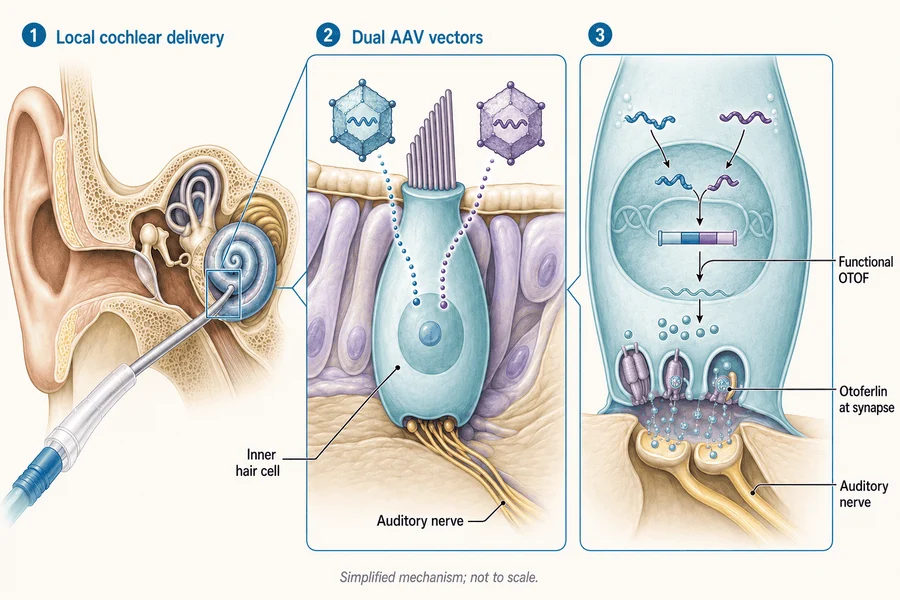
On April 23, 2026, the U.S. Food and Drug Administration granted accelerated approval to Otarmeni (lunsotogene parvec-cwha), a gene therapy from Regeneron previously known as DB-OTO. It is approved for children and adults with severe to profound hearing loss caused by changes in both copies of the OTOF gene, confirmed by genetic testing (FDA, 2026).
The OTOF gene provides instructions for otoferlin, a protein that sensory hair cells need to pass sound signals to the auditory nerve. Otarmeni is given as a single surgical injection into the cochlea (FDA, 2026).
What the results showed
Regeneron reported that in its CHORD trial, 80% of participants reached or exceeded the hearing level set as the trial's main goal, and that with longer follow-up, 42% reached hearing in the normal range, including the ability to hear whispers (Regeneron, 2026). The company also said it will provide Otarmeni in the U.S. at no cost for the therapy itself.
What it does not mean
Otarmeni applies to OTOF-related hearing loss only, which is a rare form. It does not treat hearing loss caused by other genes, and accelerated approval means the FDA may require continued evidence of benefit. Families should ask treatment centers about eligibility, the surgical procedure, follow-up care, and any costs beyond the therapy itself. For a plain-language look at how a single gene change can affect different parts of the inner ear, see How Hearing and Balance Work Together in the Inner Ear.
A trial opens for the most common genetic cause of deafness
What happened
On August 11, 2026, Skylark Bio announced that the first participant had received SKY-GJB2 in its SONIX Phase 1/2 clinical trial. The trial is for children aged 9 months to 7 years with hearing loss linked to the GJB2 gene, and the therapy is given as a single injection into one ear (Skylark Bio, 2026).
Why GJB2 matters
GJB2 provides instructions for connexin 26, a protein that helps inner-ear cells communicate with one another. The company describes GJB2-related hearing loss as the most common genetic cause of nonsyndromic deafness, meaning deafness that occurs without other symptoms, and notes that there is currently no approved treatment that addresses its cause (Skylark Bio, 2026).
What comes next
Phase 1/2 trials focus mainly on safety, with early signs of effect. Skylark Bio expects preliminary data by the end of 2026, with more results in 2027 (Skylark Bio, 2026). Until then, it is too early to know how well this approach works.
Large companies invest in gene editing for hearing loss
On January 28, 2026, Eli Lilly announced a partnership with Seamless Therapeutics, a German company that engineers enzymes called recombinases, which can rearrange DNA at precise locations. The collaboration aims to design ways to correct gene changes that cause hearing loss, and Seamless could receive more than $1.12 billion in total payments if the program reaches its goals (BioPharma Dive, 2026).
Gene editing is a different strategy from the gene replacement used by Otarmeni and SKY-GJB2. Instead of adding a working copy of a gene, it aims to correct the existing one. This kind of research is at an earlier stage, and it will likely be years before it reaches clinical trials.
Rescue Hearing's programs move to MED-EL
In June 2026, MED-EL acquired Rescue Hearing's gene therapy programs for MYO7A and STRC, along with the rights to develop, advance, and potentially commercialize them. The MYO7A program targets a genetic cause of balance disorders, and the STRC program targets a genetic cause of hearing loss (Rescue Hearing Inc., 2026). You can read the full announcement. Both remain research programs.
At a glance
| When | Development | Gene | Stage |
|---|---|---|---|
| January | Lilly and Seamless Therapeutics gene editing partnership | Not specified | Early research |
| April | Otarmeni approved by the FDA | OTOF | Accelerated approval |
| June | MED-EL acquires Rescue Hearing programs | MYO7A, STRC | Research programs |
| August | SKY-GJB2 SONIX trial doses first participant | GJB2 | Phase 1/2 trial |
The common thread: a genetic diagnosis
Every development above depends on knowing the specific gene involved. Otarmeni requires confirmed OTOF changes, and gene therapy trials typically require a confirmed genetic cause to enroll. For families, this makes genetic testing an increasingly practical step rather than only a way to understand the past. Our Genetic Testing Resources page lists places to start.
How to read hearing loss research news
Headlines about hearing loss research can move faster than the science. A few questions can help put any announcement in context:
- Which gene? Most therapies apply to one gene only.
- What stage? Laboratory and animal results are early. Phase 1 and 2 trials focus on safety. Approval is a separate, later step.
- Who was studied? Results in one age group may not apply to others.
- Who is reporting it? Company announcements, peer-reviewed journals, and regulators each play a different role.
Looking ahead
The field has moved from asking whether gene therapy can work in the inner ear to asking which genes, which patients, and at what age. The next year should bring early data from GJB2 research and more experience with the first approved therapy. We will continue to share updates as the evidence develops.
This article is provided for general educational purposes and does not offer medical advice. Descriptions of therapies and trials are based on public announcements at the time of writing and may change. Eligibility, risks, benefits, and treatment decisions should be discussed with qualified hearing, medical, and genetics professionals.
References
BioPharma Dive. (2026, January 28). Lilly bets on Seamless, delving further into genetic medicine for hearing loss.
Regeneron Pharmaceuticals. (2026, April 23). Otarmeni (lunsotogene parvec-cwha) approved by FDA as first and only gene therapy for genetic hearing loss.
Rescue Hearing Inc. (2026, June 10). MED-EL acquires two gene therapy programs targeting genetic causes of balance and hearing disorders.
Skylark Bio. (2026, August 11). Skylark Bio doses first patient in SONIX Phase 1/2 trial of SKY-GJB2 for GJB2-related pediatric deafness. BioSpace.
U.S. Food and Drug Administration. (2026, April 23). FDA approves first-ever gene therapy for treatment of genetic hearing loss under National Priority Voucher program.