
The STRC gene sits beside a nearly identical copy of itself, and that arrangement can make it harder for some genetic tests to read.
When a child is diagnosed with hearing loss, genetic testing may help explain why. Sometimes the answer is clear. Other times, a report is inconclusive, leaving families with more questions. STRC is an important genetic cause of mild-to-moderate hearing loss, but its unusual structure makes it especially challenging to analyze. Understanding that challenge can help families have a more informed conversation with their care team.
What is STRC, and why does it matter?
STRC contains instructions for making stereocilin, a protein involved in the function of outer hair cells in the cochlea, the hearing part of the inner ear. These cells have tiny hair-like projections called stereocilia. Stereocilin helps maintain connections involving these structures, supporting the inner ear's ability to respond to sound. Source: GeneReviews.
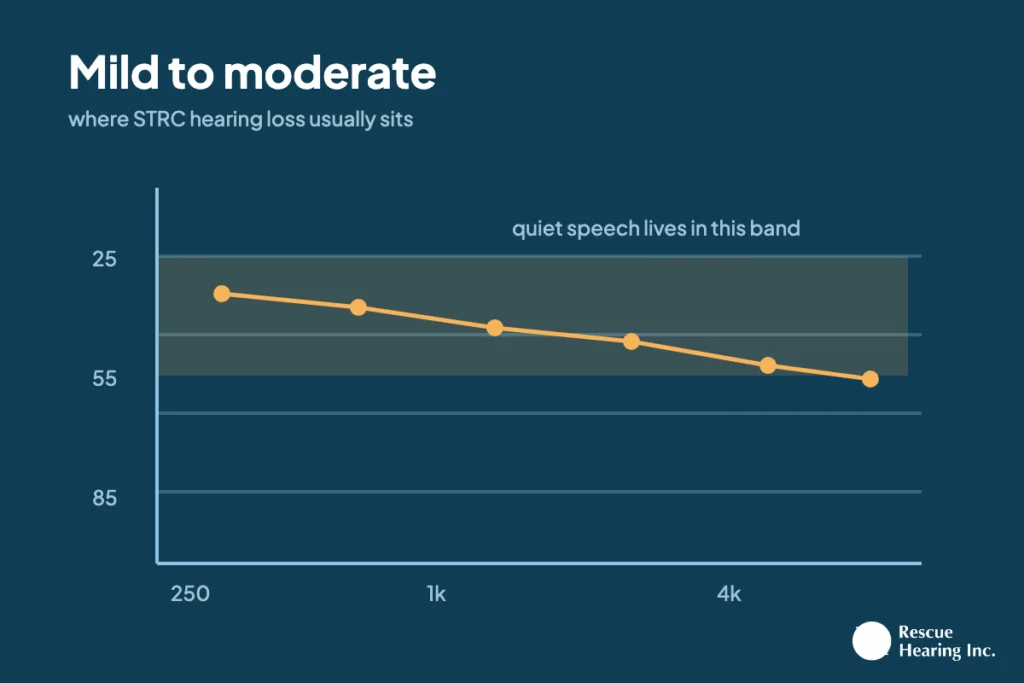
STRC-related hearing loss is generally sensorineural, meaning it originates in the inner ear. It is typically present from birth, affects both ears in a similar way, and falls in the mild-to-moderate range. Higher-pitched sounds may be more affected. Hearing can change over time in some individuals, so the pattern should not be used to predict any one person's future hearing. Source: GeneReviews, Clinical Characteristics.
STRC is not an obscure cause of genetic hearing loss. It is recognized as a leading cause of inherited mild-to-moderate sensorineural hearing loss. Estimates of its frequency vary by study population and testing approach, so percentages should always be interpreted in context. Source: GeneReviews, Prevalence.
Why STRC-related hearing loss may be missed early
Some babies with STRC-related hearing loss pass their newborn hearing screening. Screening is valuable, but certain screening protocols may not detect milder hearing differences. A passed screening therefore does not rule out all hearing loss. Families who notice concerns about listening, speech, or responses to sound should discuss them with a pediatrician or hearing-health professional. Source: GeneReviews, Diagnosis.
Why STRC can be hard to read on a genetic test
1. A nearly identical neighbor can confuse the reading
Near STRC is a pseudogene: a DNA sequence that closely resembles STRC but is not a functioning copy of the gene. Many sequencing tests read DNA in relatively short fragments and use software to place those fragments in the genome. Because STRC and its pseudogene are so similar, some fragments are difficult to assign to the correct location. Without methods designed to distinguish the two, a test can miss or misinterpret a change. Source: GeneReviews, Molecular Genetic Testing.
Think of trying to identify a sentence in a document that contains two nearly identical paragraphs. Reading the words is not enough; you also need to know which paragraph they came from.
2. A missing stretch of DNA requires a different kind of check
Many disease-causing STRC changes are deletions, in which part or all of the gene is missing. Ordinary sequence analysis looks for changes within the DNA sequence, but it does not necessarily detect larger missing or duplicated sections. Laboratories may also need copy-number analysis, which looks for changes in how many copies of a DNA region are present. Depending on the laboratory and the test, methods may include chromosomal microarray, MLPA, or other validated approaches. Source: GeneReviews, Testing Methods Table.
That is why two genetic tests described broadly as “hearing loss panels” may not be equally effective at analyzing STRC. The genes included, the ability to detect deletions and duplications, and the approach used for the pseudogene all matter. Source: GeneReviews, Genetic Hearing Loss Overview.
How STRC-related hearing loss is inherited
STRC-related hearing loss follows an autosomal recessive inheritance pattern. In most affected individuals, both copies of STRC have disease-causing changes, typically one inherited from each biological parent. Parents who carry a change in only one copy usually do not have STRC-related hearing loss themselves. This helps explain why a child may have inherited hearing loss even when there is no known family history. Source: GeneReviews, Genetic Counseling.
Why a neighboring gene may also appear on the report
Some deletions extend beyond STRC into a nearby gene called CATSPER2. When both copies of the STRC–CATSPER2 region are deleted, males may also be at risk for reduced fertility later in life. This is not a finding that applies to everyone with STRC-related hearing loss. The precise deletion and whether one or both copies are affected are important details for a genetics professional to interpret. Source: GeneReviews, Clinical Characteristics and Genetic Counseling.
What to look for in a genetic test report
If STRC appears on a hearing-loss test report—or if testing did not identify an explanation—it can be helpful to ask the ordering clinician or genetic counselor:
- Was STRC included in the genes analyzed?
- Did the test check for deletions and duplications (copy-number changes)?
- How did the laboratory distinguish STRC from its highly similar pseudogene?
- Were any findings classified as variants of uncertain significance, and what does that mean?
- Based on the hearing evaluation and the test's limitations, would any additional testing be appropriate?
A negative or inconclusive result does not automatically mean the hearing loss is not genetic. It may reflect limits of the test, gaps in current scientific knowledge, or other causes that have not yet been identified. A variant of uncertain significance, by itself, cannot confirm or rule out an STRC-related diagnosis. Source: GeneReviews, Genetic Hearing Loss Overview; STRC-Related Hearing Loss.
What support is available?
People with STRC-related hearing loss may benefit from individualized hearing care, including hearing aids, assistive listening technology, communication support, educational accommodations, and ongoing audiology follow-up. Needs differ from person to person. An audiologist, physician, and genetic counselor can help families understand both hearing results and genetic findings. Source: GeneReviews, Management.
Why STRC matters to hearing research
Because STRC is a significant cause of inherited mild-to-moderate hearing loss, it is also an important area of scientific research. Rescue Hearing developed an STRC gene-therapy program that was acquired by MED-EL in 2026. This is a research and development milestone, not evidence that an STRC gene therapy is approved, proven effective, or available as a treatment. Source: Rescue Hearing announcement.
The takeaway
STRC shows why the details of genetic testing matter. Its nearby lookalike sequence and frequent deletions can make it harder for some tests to identify a cause of hearing loss. Understanding these limitations does not provide a diagnosis, but it can help families ask better questions and make sense of a report with their care team.
If you have a genetic testing report, consider bringing it to your next appointment with an audiologist, physician, or genetic counselor. You can also share this article as a starting point for discussion.
Scientific references
- Redfield S, Shearer AE. STRC-Related Autosomal Recessive Hearing Loss. GeneReviews. 2023.
- GeneReviews. Molecular Genetic Testing Used in STRC-Related Autosomal Recessive Hearing Loss.
- GeneReviews. Genetic Hearing Loss Overview.
- Nishio SY, Usami SI. Frequency of the STRC-CATSPER2 deletion in STRC-associated hearing loss patients. Scientific Reports. 2022.
- Rescue Hearing. MED-EL Acquires Two Gene Therapy Programs. 2026.
Educational disclaimer: This article is for general education and does not provide medical advice, interpret an individual genetic test, predict hearing outcomes, or recommend treatment. Discuss personal questions with a qualified hearing-health or genetics professional.